

PRODUCT TECHNOLOGY BRIEFING | DOC. ZWP-BLMS-001 Rev. 1.0
BLMS — Bolt Load Monitoring System
Making critical bolt preload visible from installation to operation
A patented sensing washer — clamp force measured during tightening, preload monitored long after
Torque Is an Input — Not the Fastening Result
The same applied torque produces different clamp forces under different conditions
Applied torque
Must first overcome thread friction, friction under the nut or bolt head, and the resistance of stretching the bolt.
Friction & joint conditions
Only part of the applied torque becomes useful bolt tension. Higher friction, lower clamp force; lower friction, higher clamp force.
Actual clamp force
The axial load that actually holds the joint together — the quantity that governs joint integrity.
The Bolt Is Still There — the Clamp Force May Not Be
Preload can degrade during operation, often without visible warning
A bolt can look intact while its retained clamp force is already changing
Embedment and surface settling, gasket creep and relaxation, vibration and transverse loading, thermal expansion and contraction, repeated or fluctuating external loads, joint movement, wear or deformation — each changes the retained preload. And periodic inspection cannot show what happened between intervals.
2 – 200 kN
Measurement range, SWC-M20 standard reference configuration
± 1.0 % Fnom
Non-linearity (repeatability ≤ ±0.5% Fnom)
Preload loss → joint separation or microslip → leakage, misalignment, fatigue → unplanned downtime or safety risk.
Which Joints Are Worth Monitoring?
Not every bolt needs continuous monitoring — BLMS is for selected critical joints
Safety-critical
Joint integrity has direct safety consequences
The cost of failure far exceeds the cost of monitoring
Quality-critical
Joint condition affects the process or the product
Finding the deviation downstream is too late
Uptime-critical
Preload loss can directly affect availability
One unplanned stop is hard to recover from
Difficult to inspect
Hidden, remote, or costly to access
Periodic inspection is itself an expensive routine
Three Stages, One Sensing Point
Turning critical bolt preload from a one-time installation value into a lifecycle parameter
During tightening — measure actual clamp force
Clamp force is measured directly as preload is established, supporting tightening control based on the required bolt load.
After installation — establish the baseline
The initial preload baseline is recorded as the reference for all later monitoring and comparison.
During operation — monitor retained preload
Retained clamp force is monitored continuously or periodically, detecting drift and abnormal change before it becomes a joint-integrity risk.
BLMS turns bolt preload from a one-time installation result into a measurable condition throughout the joint lifecycle.
From Preload to Measurement — Five Links
The sensing washer converts bolt preload into a measurable electrical signal
Bolt tightening
Torque is applied and the bolt stretches
Bolt preload
The axial load that clamps the joint is created
Load on the washer
Preload becomes a compressive load on the sensing washer
Electrical signal
A strain gauge full bridge converts that load into a signal
Measured clamp force
The processed signal becomes a readable, recordable value
As bolt preload changes, the load acting on the sensing washer changes with it — measuring what the joint retains, not what the tool applied.
Three Components, One Data Chain
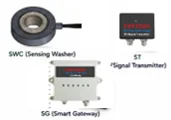
SWC sensing washer · ST signal transmitter · SG system gateway
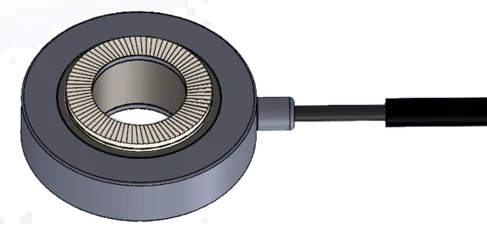
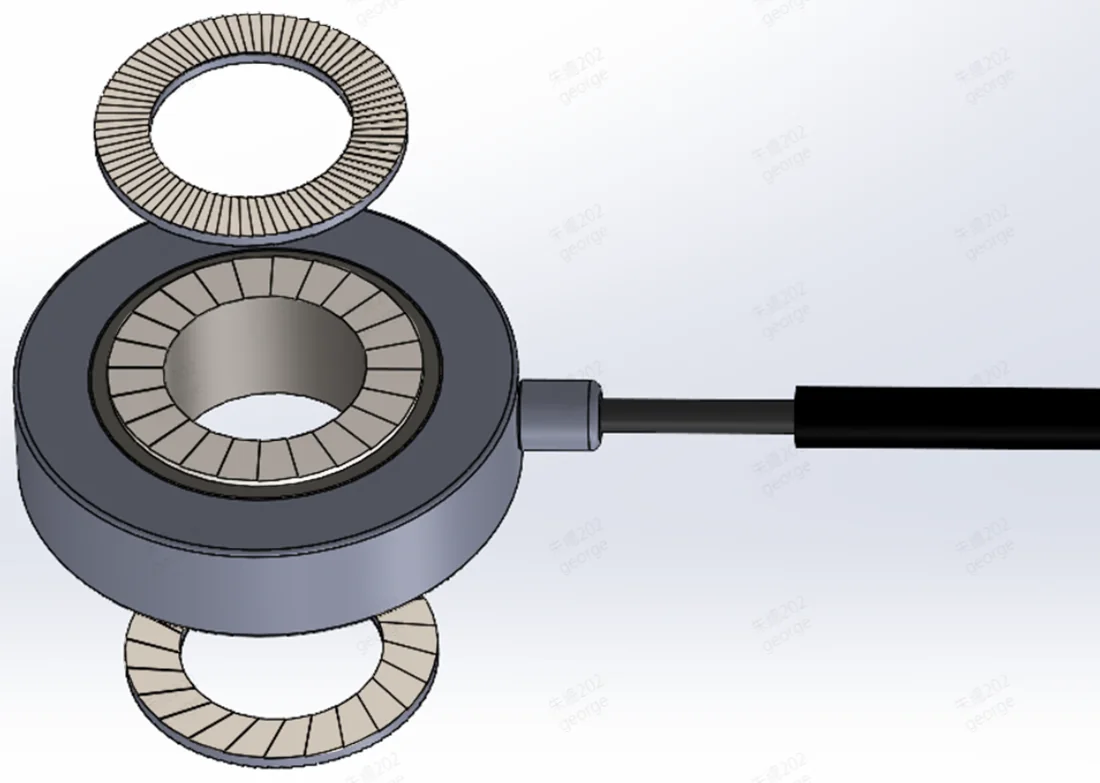
SWC — Sensing Washer
Installed at the monitored joint, directly in the bolt load path, sensing clamp force. The patented design supports adaptable anti-loosening interfaces (wedge-lock or radial-rib).
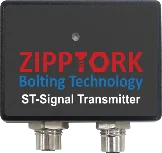
ST — Signal Transmitter
Receives the sensing washer signal, processes it, and transmits measurement data to the system (RS-485 / RF 2.4G / LoRa).
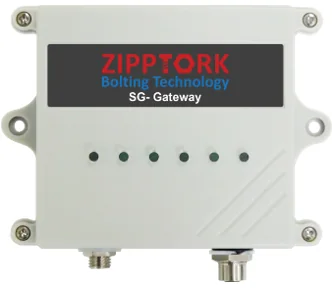
SG — System Gateway
Collects data from multiple ST units and provides communication to the monitoring system for multi-point bolt-load monitoring.
Not every bolt requires continuous monitoring. BLMS is designed for selected joints where safety, uptime, quality or inspection accessibility makes preload visibility essential.
From a Single Joint to a Multi-Point Network
Local, network or remote architecture according to project requirements
SWC — Sensing Washer
ST — Signal Transmitter
SG — System Gateway
Monitoring & Application Software
Customer System Integration
Measures clamp force in the bolt load path
Signal processing and transmission · RS-485 / RF 2.4G / LoRa
Collects multiple STs · up to 64 STs per gateway
Visualization · trends · threshold alerts · logging
LAN / Wi-Fi / Bluetooth / remote connectivity
Communication options and scalability
RS-485 wired: up to 1,000 m — for industrial wired environments
RF 2.4G wireless: up to 100 m — where cabling is impractical
LoRa (optional): up to 10 km — for remote and distributed joints
Monitoring, Alerts & Data
Turning clamp-force data into information someone can act on
Continuous or periodic
Monitoring cadence chosen to suit the application
Threshold & anomaly detection
Deviation from baseline, threshold excursions and abnormal change are flagged
History & trends
Measurement history is retained so the direction of change can be read
Integration & traceability
Connects to monitoring software or external systems for analysis and traceability
Hardware Specifications
SWC-M20 is the standard reference configuration; other bolt sizes on request
SWC repeatability
≤ ± 0.5 % Fnom
SWC overload
Safe 120% Fnom / Ultimate > 150% Fnom
Sensing element
Strain gauge full bridge
Operating temperature
−20 to +90 °C (special environments customizable)
ST size / weight
96 × 70 × 28 mm / approx. 250 g
SG size / weight
160 × 120 × 60 mm / approx. 700 g
| Component | Model | Key specification | Communication / IP |
|---|---|---|---|
| SWC Sensing Washer | SWC-M20 | 200 kN rated · 2–200 kN range · ±1.0% Fnom | 5-core shielded cable (100 m max) · IP66 |
| ST Signal Transmitter | ST | Up to 100 Hz sampling · 24-bit ADC | RS-485 / RF 2.4G / LoRa · IP67 |
| SG System Gateway | SG | Up to 64 STs per SG · built-in buffering | LAN / Wi-Fi / Bluetooth / remote · IP66 |
SWC temperature effect on zero and on span: ≤ ±0.02% Fnom/°C; weight approx. 130 g without cable. ST and SG power input 9–30 VDC; ST consumption ≤1.0 W @ 24 VDC, SG ≤5 W @ 24 VDC. Other bolt sizes (M16 / M24 / M27 / M30 / M36 and others) are available as customized configurations.
Priority Industrial Applications
Where the cost of joint failure is high and uncertainty cannot be carried
Oil & gas / petrochemical
Flange connections · high-pressure piping · severe leakage consequences
Railway & transportation
Vibration and repeated loading · strict safety regulation
Wind energy
Tower and blade root connections · very high access and repair cost
Bridges & infrastructure
Long service life · long inspection intervals, difficult access
Power generation
High temperature and thermal cycling · large downtime cost
Mining & heavy equipment
High shock, harsh environment · availability drives output
BLMS — Making Critical Bolt Preload a Visible Condition
MEASURE → MONITOR → DETECT → CONNECT
Torque controls the input; BLMS measures the result — the sensing washer sits directly in the bolt load path.
A patented adaptable anti-loosening interface: measurement and anti-loosening in the same washer.
Preload stops being a one-time installation number and becomes a condition measurable across the joint lifecycle.
A configurable architecture: from one critical joint to a multi-point network of 64 points per gateway.
Bring this to your line.
Send the fastener size, target torque and the tool you use today. A product engineer replies with the configuration that fits.
ZIPPTORK | China Pneumatic Corporation | www.zipptork.com